The Bell Witch Site
Recommended Books
The Bell Witch SiteOn Social Media
The
Bell Witch Site | Copyright © 1995
- 2025 Pat Fitzhugh On Social Media 

Pat Fitzhugh's Official Web Site
|



The Story of the Bell Witch
"America's Greatest Ghost Story"
New! 2024 Bell Witch Storytelling, Book Signing, Meet-Greet Events
About the Bell Witch
Americans continue to affirm their fascination with the unknown by making scary movies, paranormal shows, and live ghost hunts a favorite modern pastime. Despite the frights and thrills such movies and events bring about, people want something more, and different--something that intrigues them, something they can focus on and give intelligent thought to. Enter well-documented, well-researched historical hauntings, where serious, unbiased researchers pave the way for learning so that people, like you, can draw their own conclusions.
T
he legend of the Bell Witch centers on the John Bell family of Red River, Tennessee, now Adams, and the spiritual haunting they endured between 1817 and 1821. Unlike many films and ghost stories, the early-1800s Tennessee haunting involved real people and places. No one has yet to solve it--or even come close. These distinctions led Dr. Nandor Fodor, a noted lawyer-turned-parapsychologist, to call the legend, "America's Greatest Ghost Story." Fast forward 200 years, and the Bell Witch legend is still making waves. There are numerous Bell Witch books, several Bell Witch movies and documentaries, and there are always several more "in the works." Regardless of whether the case's origin was spiritual or human, it remains an epic, classic American haunting, and a "who-done-it" mystery like no other.The purpose of the Bell Witch story presented below is to provide a brief overview of the legend. For the full account of the Bell Witch legend (North Carolina + Tennessee + Mississippi; from the early 1800s to present-day), including annotations, charts, footnotes, historical endnotes and discussions, and other resources, please buy a signed, personalized copy of The Bell Witch: The Full Account, by Pat Fitzhugh. You can also get the book from Amazon and other retailers. If you have questions about the legend that are not answered at The Bell Witch Site, please ask the site's owner, 40+-year Bell Witch researcher, Pat Fitzhugh, your questions about the legend.
The story presented below is the "classic version," covering only Tennessee and the 1817-1821 period. It is only a story, and a very controversial one at that. For researched historical information pertaining to the legend's characters, please see the Real Character Biographies section of this site. For an in-depth, researched look at the legend's key background elements, please see the Bell Witch Essays section. To learn more about the legend in general, please see the Frequently Asked Questions page. And, above all else, thank you for visiting The Bell Witch Site.
- Pat Fitzhugh, Author, Storyteller, and Researcher
The Bell Family Prior to the Haunting
In the early 1800s, John Bell moved his family from North Carolina to the Red River bottomland in Robertson County, Tennessee, settling in the Red River community, which later became the present-day Adams, Tennessee. Bell purchased some land and a large house for his family. Over the next several years, he acquired more land, increasing his holdings to 328 acres, and cleared a number of fields for planting. He also became an Elder of the Red River Baptist Church. John and his wife, Lucy Bell, had three more children after moving to Tennessee. The Bells had a very happy and successful early life at the Red River Settlement.
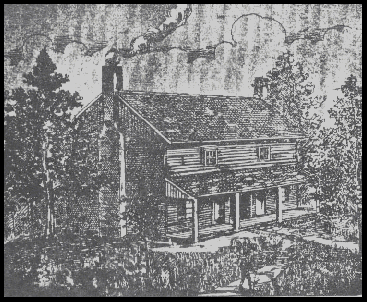
The
Bell family homestead, the alleged "ground zero" of the Bell
Witch haunting.
Strange Occurrences Commence
One day in 1817, John Bell was inspecting his corn field when he encountered a strange-looking animal sitting in the middle of a corn row. Shocked by the appearance of this animal, which had the body of a dog and the head of a rabbit, Bell shot several times. The animal vanished. This was the first documented manifestation of the entity. Bell thought nothing more of the incident, at least not until after dinner. That evening, the family began hearing "beating" sounds on the outside walls of their log home.
The mysterious sounds continued with increased frequency and force each night. Bell and his sons often hurried outside to catch the culprit but always returned empty-handed. In the weeks that followed, the Bell children began waking up frightened, complaining that rats were gnawing at their bedposts. Not long after that, the children began complaining of having having their bed covers pulled from them and their pillows tossed onto the floor by a seemingly invisible entity.
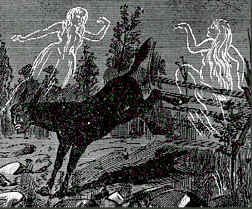
The
entity
allegedly turned a man into a mule.
The Bell Witch Develops a Voice and Becomes Violent
As time went on, the Bells began hearing faint, whispering voices, which too weak to understand but sounded like a feeble old woman singing hymns. The encounters escalated, and the Bells’ youngest daughter, Betsy Bell, began experiencing brutal encounters with the invisible entity. It would pull her hair and slap her relentlessly, often leaving welts and hand prints on her face and body. The disturbances, about which John Bell had vowed his family to secret, finally escalated to the point that he shared his "family trouble" with his closest friend and neighbor, James Johnston.
Skeptical at first, Johnston and his wife spent the night at the Bell home. Things began peacefully, but once they retired for the evening, they were subjected to the same terrifying disturbances that the Bells had been experiencing. After their bedcovers were yanked off and James was slapped, he sprang out of bed, exclaiming, "In the name of the Lord, who are you and what do you want!" The entity did not respond; the rest of the night was peaceful. The next morning, Mr. Johnston explained to the Bells that the culprit was likely an "evil spirit, the kind that the Bible talks about."
The entity's voice strengthened over time and became loud and unmistakable. It sang hymns, quoted scripture, carried on intelligent conversation, and once even quoted, word-for-word, two sermons that were preached at the same time on the same day, thirteen miles apart. Word of the supernatural phenomena soon spread outside the settlement, even to Nashville, where then-Major General Andrew Jackson became interested in the so-called Bell Witch.
The Bell Witch Ridicules Andrew Jackson's Sidekick
John Bell, Jr., along with his brothers Drewry Bell and Jesse Bell, had fought under General Jackson in the Battle of New Orleans. A few years later, In 1819, Jackson heard about the disturbances at the Bell home and decided to pay a visit and investigate. As Jackson's entourage, consisting of several men, well-groomed horses, and a large wagon, approached the Bell property, the wagon jolted to a sudden stop. It had become stuck in a muddy creek bed, and the horses were unable to pull it. At least that was what the men thought.
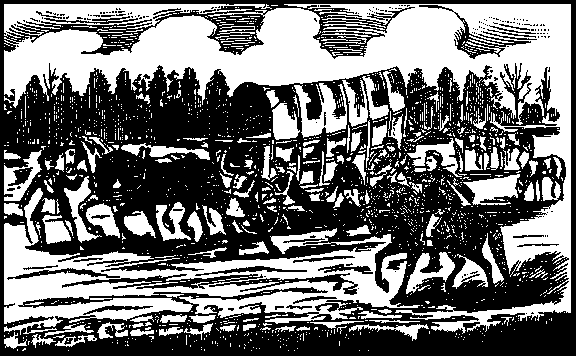
Andrew
Jackson's
entourage comes to investigate the haunting.
After several minutes of cursing and trying to coax the horses into pulling the wagon, Jackson proclaimed, "By the eternal, boys! That must be the Bell Witch!" Then, suddenly, a disembodied female voice told Jackson that they could proceed and that she would see them again later that evening. They were then able to proceed across the property, up the lane, and to the Bell home. That evening, Jackson told old war stories while his entourage set up their tents in John and Lucy Bell's yard.
One of the men claimed to be a "witch tamer." After several uneventful hours, he pulled out a shiny pistol and proclaimed that its silver bullet would kill any evil spirit that it came into contact with. He went on to say that the reason nothing had happened to them was because whatever had been haunting the Bells was "scared" of his silver bullet.
Immediately, the man screamed and began jerking his body in different directions, complaining that he was being stuck with pins and beaten severely. A strong, swift kick to the man's posterior region, from an invisible foot, sent him out the front door. Angry, the entity spoke up and announced that there was yet another "fraud" in Jackson’s party, and that she would identify him the following evening.
Now terrified, Jackson’s men begged to leave the Bell farm. Jackson insisted on staying; he wanted to know who the other "fraud" was. The men eventually went outside to sleep in their tents while continuously begging Jackson to leave. What happened next is not clear, but Jackson and his entourage were spotted in nearby Springfield early the next morning, going back to Nashville. Some allege that Jackson later proclaimed, "I would rather fight the British at New Orleans than fight the Bell Witch."
The Bell Witch Sets Her Sights on John Bell
The disturbances decreased after the Betsy and Joshua's engagement ended, but the entity continued to express disdain for John Bell, relentlessly vowing to kill him. Bell had been experiencing episodes of twitching in his face and difficulty swallowing for almost a year, and the malady grew worse with time. By the fall of 1820, his declining health had confined him to the house, where the malicious entity continuously removed his shoes when he tried to walk, and slapped his face when he recovered from his numerous seizures. Her shrill voice was heard all over the farm, cursing and chastising "Old Jack Bell," the nickname she had given him.
John Bell breathed his last breath on the morning of December 20, 1820, after slipping into a coma a day earlier. Immediately after his death, his family found a vial of strange black liquid in the cupboard. John, Jr. sprinkled two drops on the cat's tongue. The cat jumped up into the air, rolled over in mid air, and was dead when it hit the floor. The entity then exclaimed, "I gave Ol' Jack a big dose of that last night, which fixed him!" John, Jr. tossed the mysterious vial into the fireplace. It burst into a bright blue flame and shot up the chimney.
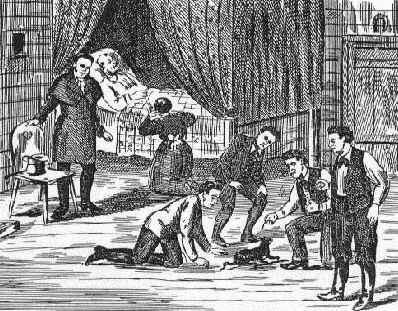
The death of
John Bell.
John Bell's funeral was one of the largest ever held in Robertson County, Tennessee. People attended from miles away, and three preachers (two Methodist, and one Baptist) eulogized him. As the crowd of mourners began leaving the graveyard, the Bell Witch entity laughed and sang a song about a bottle of brandy. Her fervent singing didn't stop until the last mourner had left the graveyard. The entity's presence was almost nonexistent after John Bell's demise, as though it had fulfilled its purpose.
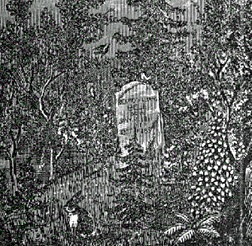
The old Bell family cemetery near present-day Adams, Tennessee.
Betsy Bell's Engagement is Disrupted
Over time, Betsy Bell became interested in Joshua Gardner, a young man who lived nearby. With the blessings of their parents, they decided to marry. Everyone was happy about their engagement. Well, almost everyone. The evil, mysterious entity became furious, and repeatedly ordered Betsy not to marry Joshua.
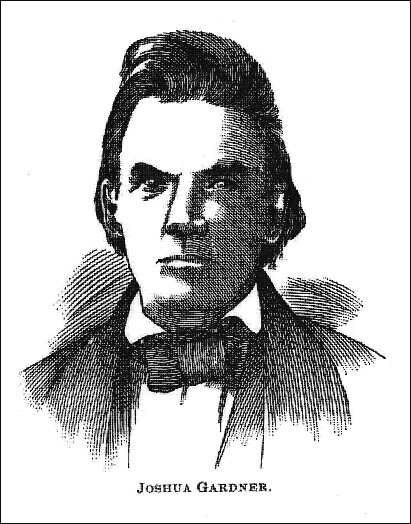
Joshua Gardner, Betsy Bell's Suitor.
Betsy and Joshua's former schoolteacher, Professor Richard Powell, had been noticeably interested in Betsy for some time and had expressed interest in marrying her when she became older. By some accounts, Powell, who was eleven years Betsy's senior, was a student of the occult, ventriloquism, a mathematical genius, and well-versed in horticulture and geology. He was secretly married to a woman in nearby Nashville, Esther Scott, during the time he lived and taught school at Red River (and perceived as a happy-go-lucky bachelor) and expressed his unwavering fondness for Betsy Bell. According to early accounts, Powell politely expressed his disappointment with Betsy's engagement to Joshua, and wished her a long and prosperous marriage.
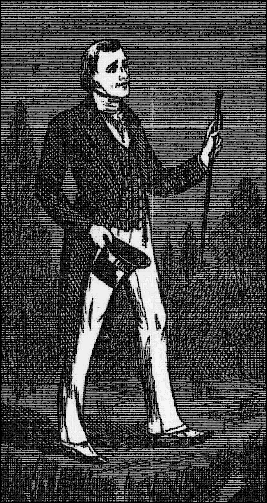
Professor Richard Powell.
Betsy and Joshua could not go to the river, the fields, or the cave to play without the entity nagging them. The constant pressure was more than Betsy Bell could handle, and on Easter Monday of 1821, she met Joshua at the river and broke off the engagement.
The Entity Bade Farewell but Returned in 1828
In April of 1821, shortly after Betsy Bell had broken off her engagement, the entity visited John Bell's widow, Lucy Bell, and told her that it was leaving but would return in seven years.
The entity returned in 1828, as promised. Most of the return visit centered on John Bell, Jr., with whom the entity discussed the origin of life, civilizations, Christianity, and the need for a major spiritual reawakening. Of particular significance were its predictions of the Civil War and other major events--some of which she missed.
The entity bade farewell after three weeks, promising to visit John Bell’s most direct descendant in 107 years. The year would be 1935, and the closest living direct descendant at the time was Nashville physician, Dr. Charles Bailey Bell, a neurologist and John Bell, Sr.'s great-grandson.
The Promised 1935 Return
In 1934, Dr. Bell published a book about the Bell Witch, likely to raise awareness of the spirit's impending return. The book contains the first-ever account of the alleged conferences between the entity and John Bell, Jr., in 1828. The author's father, Dr. Joel Thomas Bell, had allegedly taken notes during the conferences and, upon his death, passed them down to him (Dr. Charles Bailey Bell). Dr. Bell published no follow-up to his 1934 book; he died in 1945, and is buried at Bellwood Cemetery in Adams, Tennessee.
Did the Bell Witch return in 1935, as promised? Some say she did not return, or that if she did, they were not aware of it. But many say she never left the place to begin with.
Conclusion and Final Thoughts
The entity that tormented the Bell family and the Red River Settlement almost 200 years ago is often blamed for unexplainable manifestations that occur near the old Bell farm today. The faint sounds of people talking and children playing can sometimes be heard in the area, and it's not uncommon to see "candle lights" dance through the dark fields late at night. Photography is especially difficult; some pictures taken in the area show mist, orbs of light, and other phenomena, including human-like figures who were not present when the pictures were taken. Could these phenomena be related to the haunting of John Bell's family?
The cause of the Bell family’s torment 200 years ago, along with today's continued phenomena in the area--although to a lesser extent--remain a mystery. Numerous theories have been put forth, but all have been debunked. However, most researchers agree that "something" had to have caused the incidents at Red River in the early 1800s that gave rise to the Bell Witch legend as we know it today.
Who knows? It happened to the John Bell family in 1817; maybe next time it will happen to your family. Hold that thought for now. Pleasant dreams.
Copyright (c) 1995-2024, Pat Fitzhugh / The Bell Witch Site; All rights reserved. Unauthorized duplication prohibited without permission and a link-back.
More Information: Bell Witch Books Bell Witch Q&A Real Character Biographies Essays Bell Family Genealogy Early Accounts Bell Witch Movies Photos