The Bell Witch Site
Recommended Books
The Bell Witch SiteOn Social Media
The
Bell Witch Site | Copyright © 1995
- 2025 Pat Fitzhugh On Social Media 

Pat Fitzhugh's Official Web Site
|





Bell Witch Character Biography
Professor Richard R.P. Powell (1795-1848)
Born in Halifax County, North Carolina, Professor Richard Rowell Ptolemy Powell figured prominently into the legend of the “Bell Witch” because of his having taught several of the Bell children, and his admiration and later marriage to Elizabeth "Betsy" Bell. In fact, some have stated that Powell was the "brains" behind Kate. Although the author feels this was possibly the case, he is not fully convinced.
After receiving an advanced education in his native North Carolina, Powell moved to Tennessee about 1815 and settled near the village of Nashville. As he explored various teaching opportunities there, he learned of the flourishing Red River Settlement in Robertson County and the need for a schoolmaster. He soon moved there, settling near the Bell farm. Some say he even rented a room in the Bell home, but this has yet to be proven. [1]
Powell began teaching in a small schoolhouse situated on a tract of land donated by James Johnston, a few yards east of the Bell property line. Having taught several of their children, he became good friends with John and Lucy Bell.
He developed a strong fondness for Betsy as she matured into adolescence. But despite his frequent visits to the Bell home and the compliments he often paid her, was already courting Joshua Gardner, a well-respected and close neighbor whose age was much closer to hers. Both families were pleased with the courtship; however, it seemed that neither Powell nor Kate shared their enthusiasm.
Betsy broke off the engagement on Easter Monday of 1821, after Kate’s pressure had taken a heavy emotional toll on her. Powell visited her frequently during the period of grief and loathing that ensued, often reciting poetry to help lift her spirits. A courtship gradually evolved between the two that would last three years and culminate in their marriage on March 21, 1824.
Surprisingly, and without the knowledge of anyone in the Red River Settlement at the time, Richard Powell’s marriage to Betsy was not his first. He had earlier married Esther McKenzie Scott of Dickson County, Tennessee, who was 18 years his senior. The circumstances of their union are unknown, but in those days, especially, it was very odd for the wife to be older than the husband, and in Esther Scott Powell's case, almost two decades. Socially, Richard Powell never mentioned his "hush-hush" marriage, but referenced to it in his personal diary. [2] A reference to his settling of her estate is also made in the Robertson County public records. [3] Esther Scott conveniently died in 1821, a few months after John Bell, Sr. died, and the same year in which Betsy broke off her engagement to Joshua--and three years before she wed Powell.
In the years that followed, Powell's involvement in society and politics required him to relinquish his schoolmaster job to pursue a career in politics. Powell served as Sheriff of Robertson County between 1830 and 1833, and was elected to the Tennessee House of Representatives in 1833, where represented Robertson County in the 20th Tennessee General Assembly. He made a name for himself as a lawmaker of great ability, and gained wide popularity throughout the state. Powell had also been a Captain in the Tennessee Militia, a census enumerator, and a Justice of the Peace. [4]
Powell’s personal diary alluded to earlier was his “Ciphering Book,” a 271-page collection of advanced math problems, genealogical notes, and other information. It is believed that many of the math problems in Powell’s “Ciphering Book” were created by his father, Richard Powell, Sr., who also was a well-educated man. According to dates listed in his “Ciphering Book,” Richard Powell solved many of the math problems between 1812 and 1822. The “Ciphering Book” makes no mention of the “Bell Witch” disturbances. It does, however, contain an entry noting the date on which he married Betsy Bell. [5]
At the pinnacle of his political career, Powell suffered a massive stroke that rendered him unable to fend for himself and his family. The Powells purchased a keelboat to ship goods to New Orleans in hopes of raising money. On the night before the first shipment was to have set sail, all goods were lost when a misguided steamboat crashed into the vessel while moored in nearby Clarksville, Tennessee, awaiting daybreak.
The substantial monetary loss, coupled with Powell’s inability to earn a living, left his family broke and destitute. A number of Powell’s friends, including a certain “Joshua Gardner,” then of Henry County, Tennessee, drafted and submitted a petition to the Tennessee State Legislature that sought financial relief for Powell and his family. The petition was rejected. [6]
Richard Powell’s condition slowly worsened until his death in January of 1848. He is buried in an unmarked grave near the Cedar Hill community of Robertson County, Tennessee.
Richard Powell was never around when Kate put on demonstrations, and neither spoke nor wrote of her. Interestingly, several accounts allege that Powell was involved with the occult. One such account describes an incident that took place at the schoolhouse, involving Calvin and John Johnston who, while walking down the road by the schoolhouse one evening, noticed the glare of a candle burning inside. Having time to spare, they decided to visit Professor Powell.
After several unanswered knocks, they decided to enter. Unable to find Powell, they stood and waited next to his desk, casually glancing at the many books. Powell soon arrived, running quickly to his desk and putting away a book that had been left open. Calvin apologized, stating that he was “just glancing” and had not read the book. Powell said it was an old Latin book and not important. Well-versed in Latin and Greek, Calvin later commented that nothing in the book appeared to be Latin (or Greek).
Some might assume the book was Powell's “Ciphering Book.” The author, also well-versed in Latin, has reviewed Powell’s “Ciphering Book” in meticulous detail and concluded that its contents are easily decipherable, including the occasional use of Greek symbols in math problems. The author does not feel that the book was Powell’s “Ciphering Book.”
Another account of Richard Powell’s alleged involvement with the occult comes from a descendant of Joshua Gardner’s younger brother, John A. Gardner.
Several children, including some of the Gardner and Bell family, were walking home from school late one afternoon and discussing a difficult problem that Professor Powell had asked them to solve. As they continued walking, they became more confused and decided to return to the school house and ask Powell for clarification. They found the door locked, but heard the distinct sound of Professor Powell’s voice coming from inside, speaking in a language that was unknown to them. Upon hearing their knocks, Powell ceased speaking and opened the door, saying that he must have been daydreaming and that no one else had been present.
Talk among community children regarding Professor Powell’s “incantations” continued for months. Is is said, but has not been proven, that Powell severely punished several of them upon learning of these conversations.
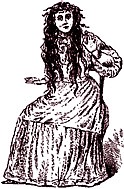
[1] Richard Powell’s photo from Authenticated History of the Bell Witch, M.V. Ingram, 1894.
[2] "Richard R. P. Powell and Esther Scott was married on the Seventh Day of December, Eighteen Hundred & Fifteen, in the Twentieth year of my Age, on the day before my Birthday. It being Thursday." Richard Powell, Ciphering Book, TN Manuscript Accession Number 75-260, p. 179.
[3] Robertson County TN, Will Book 3, pp. 506-507; Robertson County TN, County Court Minutes Book 6, p. 392.
[4] Tennessee Legislative Encyclopedia.
[5] Richard Powell Ciphering Book, TN Manuscript Accession Number 75-260, p. 222.
[6] Tennessee Legislative Petition #54-1837-01.